- Pick what you need and give your kitchen's ZIP code.
- Each service goes to the number of local companies you choose, from one to five. We check licenses where the law requires one and email you their names.
- You talk with them and decide. You hire and pay the company directly.
Facts checked 2026-11-02.
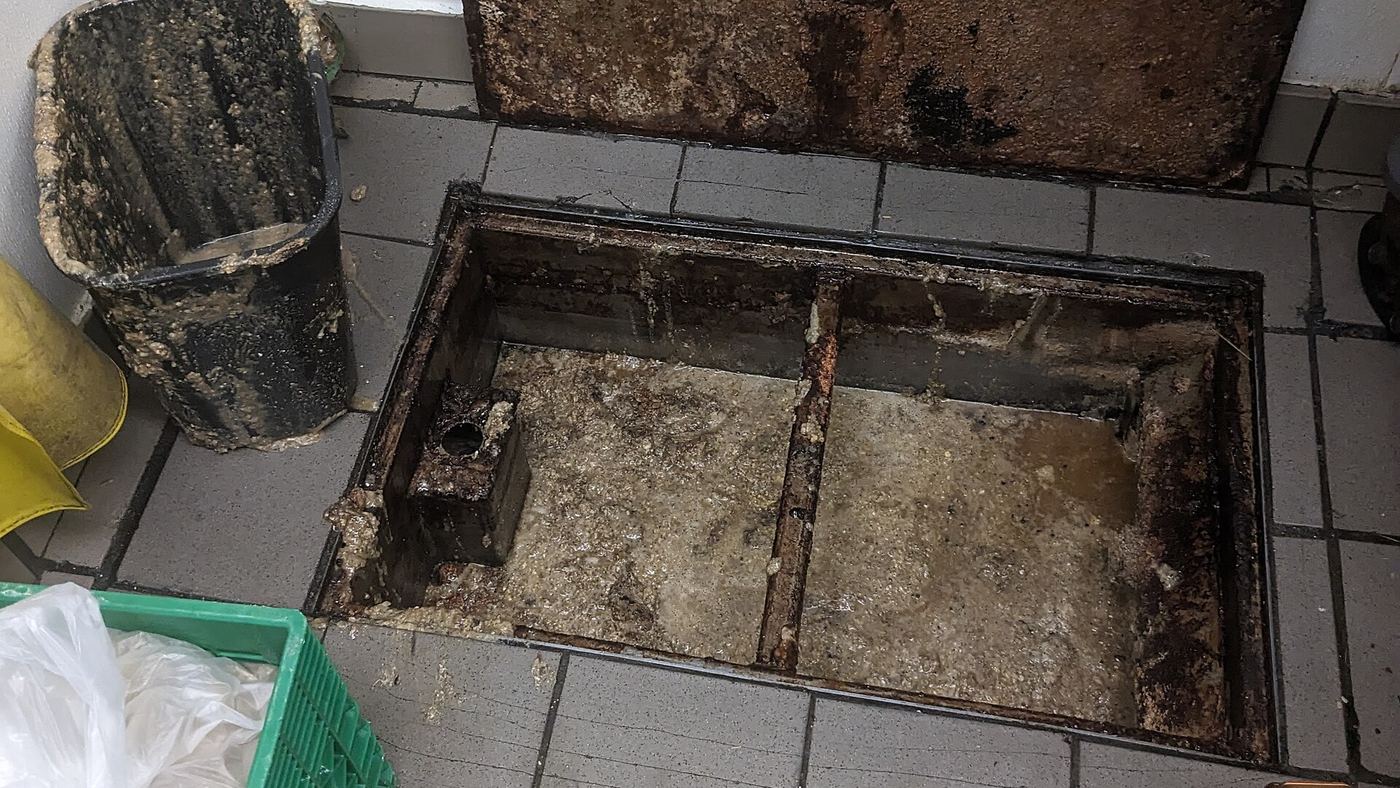

In Georgia, the health rules say where a restaurant grease trap goes and that you can reach it. The state Environmental Protection Division (EPD) regulates the trucks that pump it. Your city or county sewer utility sets the local program, including the permit, the trap size and the inspections.
A grease trap must be easy to reach
The Department of Public Health food service rules, Rule 511-6-1-.06, cover drains in a food service kitchen. Where a grease trap is used, it must be located so that it is easy to reach for cleaning. When you design the kitchen, put the trap where a hauler can get to it.
State rule on who may pump
EPD Rule 391-3-6-.24 covers the transport of commercial waste. The rule counts the contents of a grease interceptor at a food business as commercial waste. It calls the owner or operator of the interceptor the originator. That is you.
For the hauler, the rule requires:
- State registration. Any transporter that owns or operates a tank truck for commercial waste in Georgia registers with EPD. The registration number starts with "FOG".
- A local permit for every truck. The local government inspects each truck to make sure it is leak proof, durable, easy to clean and in good repair. It issues one permit per truck, and the permit is valid across the state. The local government has 30 days to issue or deny the permit.
- A full pump-out. The transporter removes the entire contents of the interceptor.
- An approved place to dump. The waste goes only to an authorized facility, for example one with a wastewater discharge permit or a permitted solid waste facility. It may not be mixed with hazardous waste or septic waste.
- A manifest. The transporter fills out one manifest per location serviced, with a section each for the originator, the transporter and the disposal site. Within 30 days it sends the originator a copy signed by the disposal site operator, and it keeps the last 30 days of manifests in the truck.
A local company can take it from here. One form, free for restaurants.
Get connectedYour duties as the originator
As the originator, you may have the waste removed only by a transporter with a valid permit. You must also keep your manifest copies for three years and make them available for inspection.
Before you pay, ask the hauler for its EPD registration number and the local permit number for the truck. EPD's FOG page says the hauler registration form is posted through the Southeastern FOG Alliance.
The local program
Most of what a restaurant sees day to day comes from the local sewer utility.
In the City of Atlanta, the Department of Watershed Management runs a Grease Management Program. Food service facilities apply, pay a permit fee set by the number of traps and make themselves available for inspections. Trap type and sizing fall under section 154-297.01 of the Grease Management Ordinance.
Before a plumbing permit, the city asks for site plans and for floor plans that show the kitchen equipment and its tie-in to the sanitary line. It also asks for trap specifications with the company, model number and a cross-section. An existing trap needs as-built drawings and field verification. The program office can be reached at 404-546-1503.
Gwinnett County has run a FOG prevention program since 2000, and county inspectors check businesses. The county's ordinance covers restaurants and also day cares, assisted living, schools, hotels, hospitals and any other place that operates a commercial kitchen. The Grease Management Program number is 678-376-6713.
Pump-out schedules are local. Ask your utility's FOG program how often your trap must be pumped and what records it wants.
Daily grease habits from Gwinnett County
Gwinnett's kitchen best practices apply to any kitchen. The county lists these:
- Put screens on drains.
- Dry-wipe pots, pans and plates before washing.
- Post FOG procedures over sinks.
- Run floor drains and mop sinks through the grease trap.
- Never pour used fryer oil down a drain. Store it in a recycling container instead.
Choosing a hauler
Look for a company that is registered with EPD and whose trucks are permitted. Ask for the numbers, write them down and keep them with your manifests. The rule requires a manifest for every location serviced, so expect one at each visit.
A grease trap pump-out request sent through the form goes to one EPD-registered local hauler in Georgia.
Questions
Who regulates grease hauling in Georgia?
EPD under Rule 391-3-6-.24. Haulers register with EPD, and the local government inspects and permits each truck.
What is a grease trap manifest?
A form with sections for the restaurant, the hauler and the disposal site. You keep your copy for three years.
How often must a Georgia grease trap be pumped?
The state rule does not set a number. Ask your local sewer utility's grease (FOG) program what it expects at your address.
Does a grease trap need to be easy to reach?
Yes. Rule 511-6-1-.06 says a grease trap, if used, is located so it is easy to reach for cleaning.
Can I pour used fryer oil down the drain?
No. Gwinnett County tells restaurants to store used oil in a recycling container and never to pour it down a drain.